
What and how to Pack?
Updated June, 2026
Packing Strategies
There are two common packing strategies we recommend:
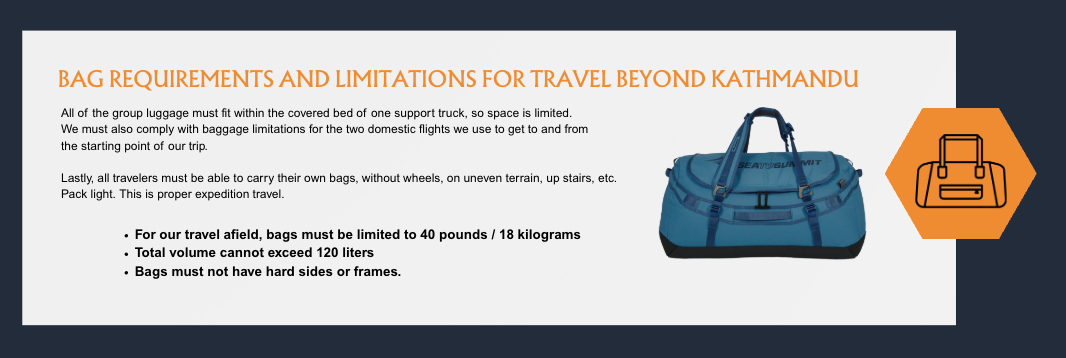
Pack all of your gear in one main bag and use it for the full duration of your trip. This can be tricky as the bag cannot exceed 40 pounds or 120 liters while underway. It’s a little easier to achieve on our hotel-only trips.
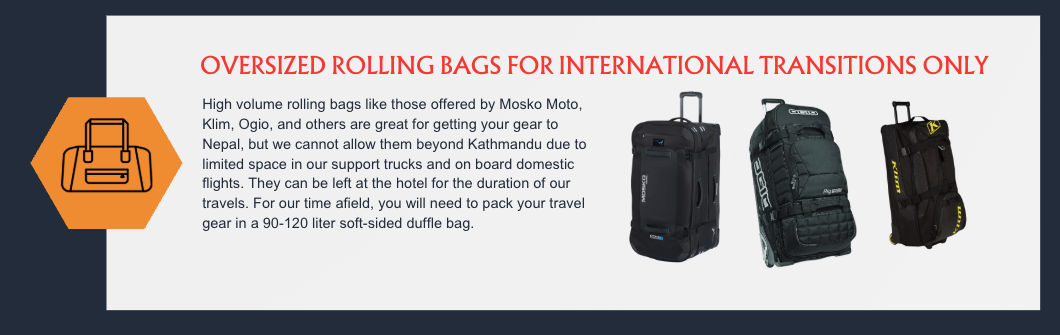
Bring two bags, one to get your riding gear and extra apparel to Nepal. The other to use while underway on the trip. You can pack in a smaller bag easily since you will be wearing your motorcycle gear during the ride. The extra bag can be stored at the host hotel in Kathmandu for the duration of the trip.
For our domestic flights to and from the starting points, we will provide extra duffles for things like helmets, jackets, etc. Please note - this is not one duffle per traveler. We will share space as to not exceed our airline baggage limits.

GENERAL APPAREL
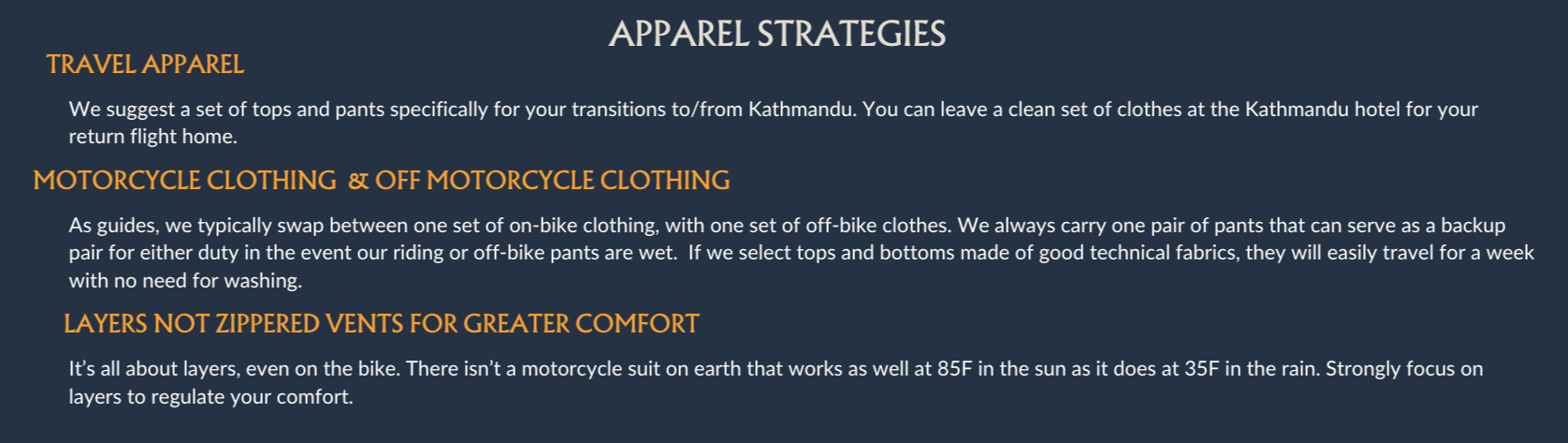
We suggest proper travel clothing for your time outside of Kathmandu. Avoid cotton as much as possible and fabrics which take a long time to dry. It’s best to travel with synthetic pants, light and soft merino wool t-shirts, or synthetic blend tops and bottoms. Look for recommended brands in the hyperlinks provided below.
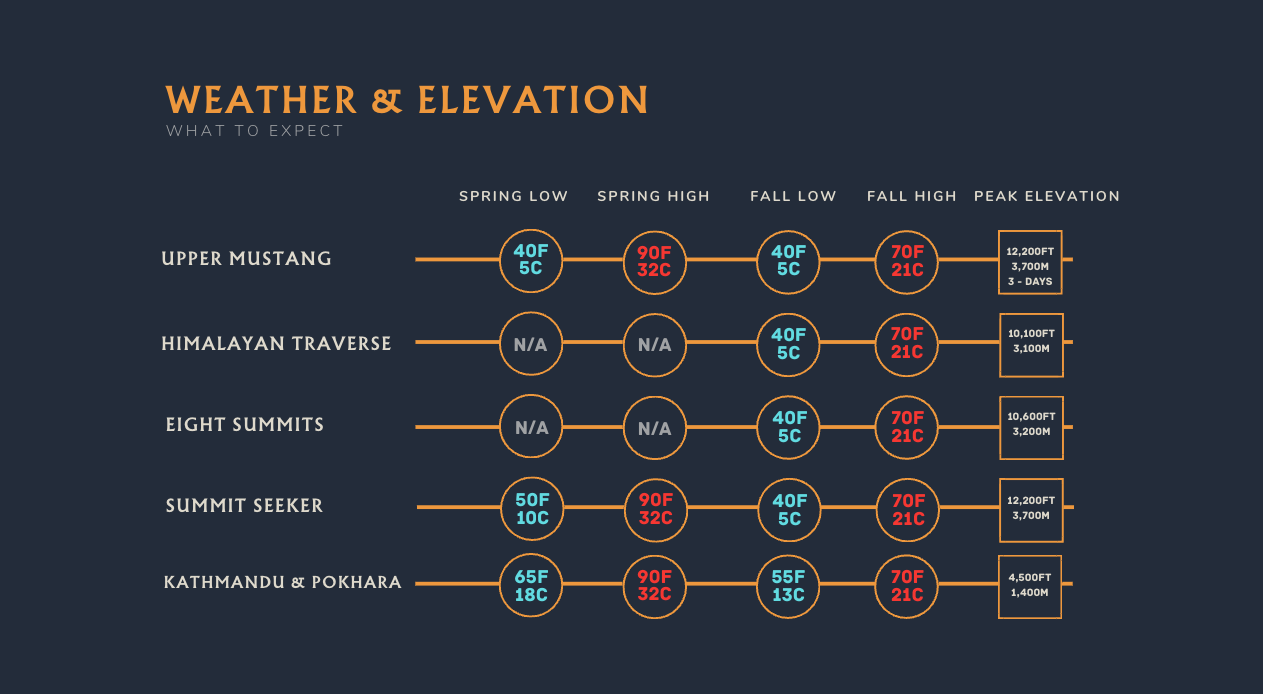
You can expect a wide range of temperatures on all of our expeditions.
We recommend:
The linked products below are merely suggestions and often represent the best of breed in the category. Less expensive options are always available and provide the same functionality.
Light pants x 2. Anything that dries quickly is best. Hit up your local REI or Sierra Trading Post for products from Kuhl, Outdoor Research, Exofficio, etc. (This is in addition to motorcycle pants for motorcycle trips) We love pants by Swedish company, Fjallraven. Our lead guide wears their KEB Trousers daily for weeks at a time.
2-3 t-shirts. We like Icebreaker as you can wear them for a month and they never stink, but they are expensive. Any non-cotton shirt works fine and if you still prefer cotton, it’s not a problem. If it gets wet it will just take longer to dry.
Lightweight long sleeve shirts . For cooler fall trips, maybe bring a couple. Quick drying is the key. We recommend options for lightweight full coverage to defend against sun and bugs (spring).
4+ pairs of undies. Exofficio is our favorite brand. Treat yourself to Exofficio undies. Trust us. We know.
Lightweight base layers, tops and bottoms if it gets chilly. This is more important for fall trips. Less so for spring adventures.
Rain jacket. This is essential gear. Do not visit the Himalayas without waterproof layers. Rain pants are also a great idea for on the bike. In the fall season rain storms are very cold. You cannot get wet. As a team we use REVIT Cyclone 2 rain jackets and have tested them in the worst rainstorms in Nepal.
Light jacket or fleece to wear when it gets cool.
Insulated jacket - This is a must have. For spring and early fall trips (October) a light down or synthetic filled “puffy” jacket is fine. Something like an REI Microtek Hooded Jacket or Patagonia Nano Puff synthetic fill jacket is perfect. For late November trips, you will want to either add more insulating layers or bring a thicker down jacket like a Cotopaxi Fuego Down Jacket.
Socks x 3 - try not to use cotton. Buy Darn Tough. Guaranteed for life and amazing! Our lead guide can wear one pair for 7-9 days.
Warm hat. Light and warm gloves are a good idea also, but primarily for the fall.
Cheap and thin flip-flops for hotels, showers, and shuffling around.
If you're wearing motorcycle or heavy hiking boots during the trip, bring light shoes with you to wear around camp.
Shorts - Not to say you should not bring shorts, but there will be several occasions when long pants are best. In Kathmandu we often visit sacred temples and shrines where shorts are not culturally appropriate. In October we also venture into the lower mid-hills where mosquitos are still present and while things like dengue fever are not always common that time of year, we like being as covered as much as possible.

PERSONAL ITEMS
We recommend a few small items for our time in the backcountry.
Headlamp or very small flashlight - This is a must-have item. (Do not rely on your phone, as phone charging is already challenging)
Water bottle. At least a 1-liter bottle. The best travel bottle ever is the Hydrapak Flux 1L.
light travel towel like our favorite from Pack Towl. Their Personal Towel is perfect for our trips. It’s not a bad idea to bring one large towel and one smaller towel.
Hand sanitizer
Sunglasses
Sunscreen
One of the best things you can pack are Shower Pouch full-size shower wipes. There are lots of things like them, but trust us, nothing is remotely as good as a Shower Pouch towel. They really are worth the added expense. Drop them in hot water for a few minutes and bam! A great refresher.

Travel Health Items (Suggested, not required)
You may want to bring a few things to ensure you are in tip-top health. Any change of diet can create tummy troubles:
Pepto Bismal tablets - Our medic suggests everyone pop one now and then to stabilize your system. Most minor tummy troubles are quickly fixed with a Pepto tab every morning.
Anti-diarrhea meds - Imodium or similar are recommended. Again, this is not to fight off a genuine illness, but traveler’s tummy.
Antibiotics - In the event your stomach takes a turn, a cycle of antibiotics might be the best course of action. Ask your doctor for a prescription of azithromycin. Cipro is a common travel antibiotic but it is not as effective in Nepal.
Cold medications - Even if you don’t get a cold, these medications are good for sudden bouts of allergies or other minor issues.
Electrolyte tablets - In the event you go a round with a bad stomach, replacing electrolytes is a good idea.
EQUIPMENT (For trips with camp accommodations)
The only trips with camping accommodations for 2026/27 are the Great Himalayan Traverse and Eight Summits Expeditions.
You don’t need to bring much, but there are a few essentials you should pack, only for our expedition packages with nights of camping.
Sleeping bag. Please bring a bag rated to 20°F for trips in October and November.
Camp Pillow. We prefer inflatable pillows from Seat to Summit, or Nemo Equipment. Our preferred head-bed is the Sea to Summit Aeros Down Pillow. It’s not cheap, but it truly is amazing. Find it here: Sea to Summit Aeros Down Pillow
Sleeping pad. Make sure it is quite small, like the Thermarest NeoAir Venture or Klymit Static V. If it is too big when packed, we will have a challenge transporting it.
Large 3-person tents are provided by Far Xplorer. Each traveler gets their own private sleeping tent.
Please do not bring backcountry water filters, stoves, cups, or other camping related items. We provide all the high quality, native grown coffee you can drink, so please do not bring coffee makers, coffee, etc. Remember - space and weight is limited. Choose your pounds carefully.
OUR FAVORITE DUFFLES & BAGS

Eagle Creek No Matter What Wheeled Duffle 110L. We absolutely love this bag for the quality and value. What we like most is the lightweight construction that retains durability thanks to heavy rip-stop fabric. The wheels are functional and it holds a surprising amount of gear. It's very stripped down, which does come with sacrifices. It doesn't have backpack straps like the Eagle Creek Migrate Wheeled Duffel Bag, which is another great choice. This is our new favorite bag for the price.
GUIDE’S CHOICE: Eagle Creek Wheeled Migrate Duffle 110-liter. We have a dozen of these bags. Some of them have made five or six laps of the earth. They are durable, light, and the wheels work quite well for a soft bag. Backpack straps make for hands free carry, and the many grab handles are very useful. This is a brilliant bag.
Patagonia Blackhole Duffel Bag 60 and 90-liter. A longtime classic. Nearly waterproof, light, and durable, the price is really great for what it is. This is a very popular and effective bag for many or our travelers.
Osprey Transporter Duffel 120-Liter. They don’t give these things away, but they are nice. Perfect for any of our trips.
THE ICONIC, CLASSIC, AND LEGENDARY EXPEDITION BAG:The North Face Basecamp Duffle 95-Liter. This is the classic duffle for expeditions in the Himalayas, and around the world. It is perfect in every way. The large trunk-style opening makes it easy to load and unload. The pack straps are comfortable and convenient. This bag has been around for decades and for good reason. The size Large version is perfect for our trips.


If you have questions about what to bring, please contact us! We’re here to help.